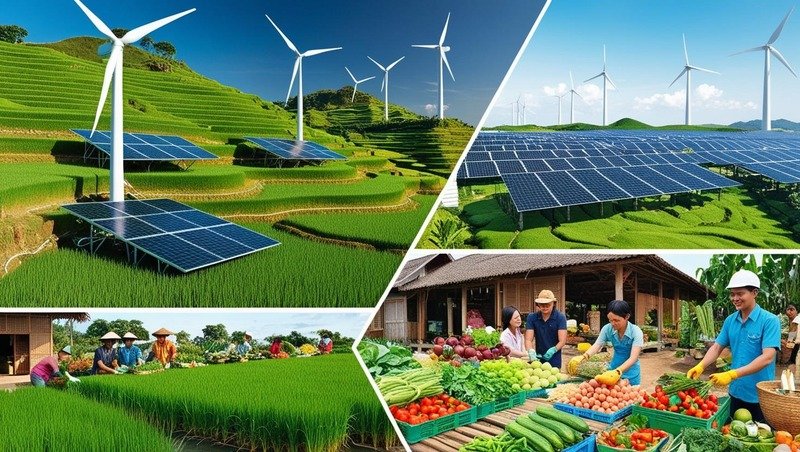
Illustration of Southeast Asia’s Green Economy. Source: Greenpressnet
JAKARTA, GREENPRESSNET — Amid global economic uncertainty and mounting climate crisis pressures, Southeast Asia is beginning to find its path forward: a green economy grounded in a system-based approach. This is the key message of the 6th edition of the Southeast Asia’s Green Economy report, recently launched by Bain & Company, GenZero, Google, Standard Chartered, and Temasek.
The report outlines that Southeast Asia—particularly six core nations (SEA-6)—can unlock high-value green economic growth if the energy transition is treated as a systemic challenge, not merely as isolated projects.
The result? Up to USD 120 billion in additional GDP, 900,000 new jobs, and closing up to 50% of the region’s emissions gap by 2030.
“We can no longer rely on patchwork solutions. We must think systemically and cross-sectorally to enable the green economy to grow quickly and inclusively,” said Dale Hardcastle, Partner & Co-Director of the Global Sustainability Innovation Center at Bain & Company, to Greenpressnet (May 22, 2025).
Systemic Solutions for Complex Problems
Three key sectors are in focus: sustainable bioeconomy, next-generation power grids, and electric vehicle (EV) ecosystems. The bioeconomy currently accounts for 25–30% of the region’s employment, but also contributes to one-third of total emissions.
Major reforms in land rights, supply chains, and the adoption of low-carbon technologies are essential to boost productivity without harming forests.
On another front, Southeast Asia’s power grids are deemed unready for the renewable energy era. Investments in energy storage systems, microgrids, and cross-border interconnections are needed to reduce decarbonization costs by up to 11% by 2050, while expanding access to clean electricity.
Meanwhile, the land transportation sector remains a growing source of emissions. With low EV adoption and fossil-fuel vehicles dominating the roads, Southeast Asia risks falling behind in the global automotive revolution.
“A dual strategy is needed: boost EV adoption and build local manufacturing. Without this, we risk losing industrial advantages we’ve held for decades,” the report stated.
Three Key Enablers: Financing, Carbon Markets, and Green AI
Beyond technology and infrastructure, the report highlights the importance of innovative financing, carbon markets, and smart technologies (Green AI). The region currently faces a climate finance gap exceeding USD 50 billion. Blended finance schemes, infrastructure funds, and results-based financing are emerging—but require standardization to scale effectively.
“We see huge opportunities to finance this transition. We’re ready to support our clients in becoming part of the solution,” said Donny Donosepoetro OBE, CEO of Standard Chartered Indonesia.
Southeast Asia is also beginning to make progress in carbon markets, though acceleration is needed. Stronger financial incentives and enhanced cross-border coordination could unlock massive potential.
Regional Cooperation Is Key
With the 2030 climate targets fast approaching, cross-country collaboration within Southeast Asia and the broader Asia-Pacific is essential. Interconnected markets in energy, trade, and technology have the power to drive a faster and more effective green transformation.
“We have no time left to delay. Systemic transformation must begin now,” stated Franziska Zimmermann, Managing Director of Sustainability at Temasek.
With major green economic opportunities on the horizon, Franziska emphasized that Southeast Asia must now move away from piecemeal efforts and embrace a collaborative, system-based, and sustainable strategy.
“As climate risks rise, this is precisely the right time for the region to rewrite its growth story—from merely chasing numbers to building progress that is fundamentally intertwined with sustainability,” she concluded. (Reported by Marwan Aziz)